
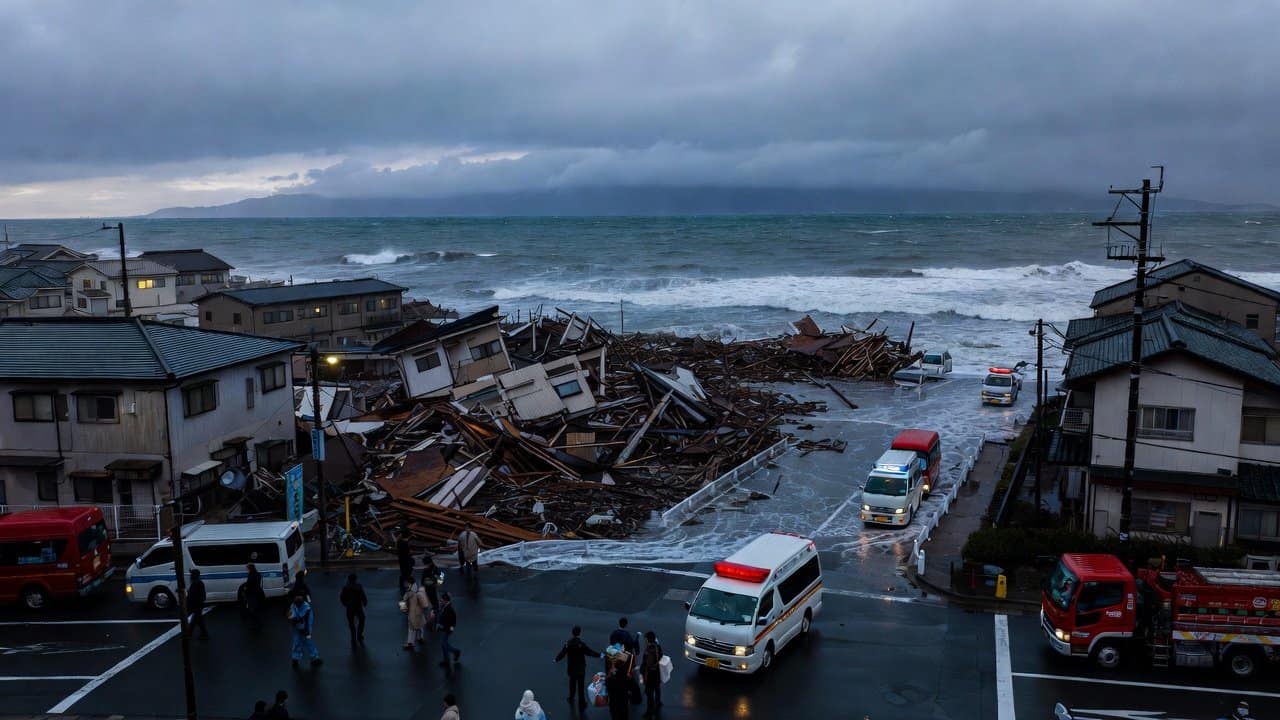
A powerful offshore earthquake near northern Japan set off a tsunami warning on Monday morning U.S. time, prompting urgent evacuation guidance along parts of the Japanese coast.
Japan’s Meteorological Agency said the quake struck in the Sanriku region, about 100 km east of Miyako, at roughly 3:52 a.m. EDT on April 20. In its initial report, the agency listed the quake at magnitude 7.5 and about 10 km deep, with strong shaking recorded across a wide stretch of the country.
A Strong Quake Off Japan’s Northeast Coast
The first official details showed this was not a small offshore tremor that passed quietly. Japan’s Meteorological Agency said the strongest shaking reached seismic intensity 5 upper in Hashikami, Aomori Prefecture, while tremors were felt from Hokkaido down to the Kinki region.
That wide footprint is one reason the warning drew so much attention so quickly. The quake also raised concern for long-period ground motion in parts of Miyagi and Akita.
The Pacific Tsunami Warning Center then issued an international tsunami threat bulletin based on preliminary parameters from JMA.
That bulletin said hazardous tsunami waves were possible for coastlines within 300 km of the epicenter, specifically along parts of Japan’s coast. It also listed Hachinohe as one location with an estimated initial wave arrival time of 8:34 UTC, which was 4:34 a.m. EDT.
Where the Tsunami Warnings Were Issued
According to JMA, tsunami warnings were issued for the central Pacific coast of Hokkaido, the Pacific coast of Aomori, and Iwate.
Tsunami advisories were also issued for eastern and western Pacific coastal areas of Hokkaido, the Sea of Japan coast of Aomori, plus Miyagi and Fukushima. JMA’s tsunami bulletin page showed that tsunami warning or advisory products were active for this event.
That matters because tsunami warnings and advisories are not routine wording. A warning signals a real risk of damaging coastal impact.
An advisory still means people should stay out of the water and away from shorelines, harbors, and river mouths. In this case, officials made it clear that the danger was tied not only to the first wave, but to repeated waves that can continue arriving after the initial hit.
What Authorities Told People To Do Right Away
JMA’s guidance was direct. People in coastal areas and along rivers were told to move immediately to higher ground or evacuation buildings and to stay there until the warning was lifted.
The agency stressed that tsunami waves can come again and again, which is why returning too early can be dangerous even after the first wave seems small.
The PTWC bulletin carried the same tone. It said government agencies in threatened coastal areas should inform at-risk populations, and people in those areas should follow instructions from national and local authorities.
That is the key point in any fast-moving tsunami event. The first alert gets attention, but the official follow-up instructions are what save lives.
Why The Situation Still Needs Close Attention
JMA also warned that the region could see stronger shaking over the next week, with the first two to three days being especially important.
A later JMA advisory said the possibility of another large earthquake in the broader Hokkaido and Sanriku offshore zone was considered relatively higher than usual after this event.
For now, the biggest takeaway is simple: this was a major offshore earthquake followed by official tsunami warnings, not online rumor or recycled panic.
The facts that matter most all came from the same place: Japan’s own weather agency, backed by the Pacific Tsunami Warning Center’s international bulletin and USGS earthquake records.