
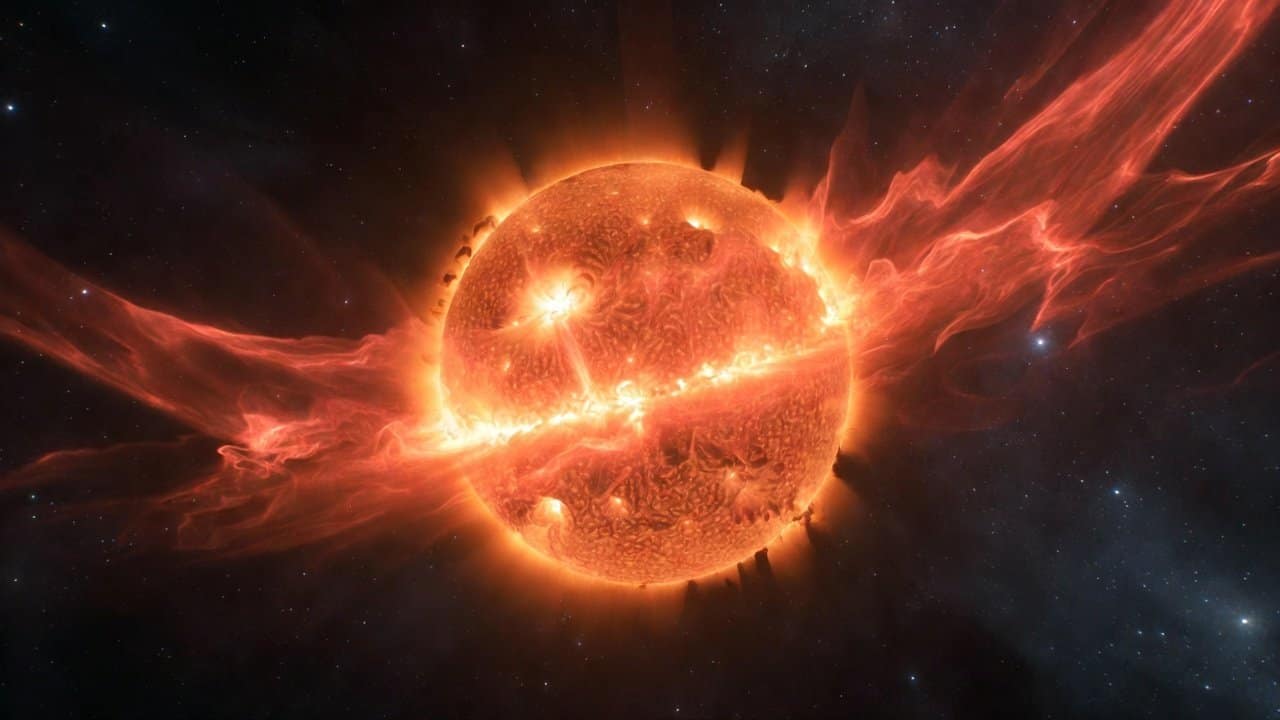
Solar flares are a captivating phenomenon that can affect not only space weather but also life here on Earth. When these bursts of energy and radiation erupt from the sun’s surface, they can cause significant disturbances in space. For anyone living on Earth, understanding solar flares is essential, especially in today’s high-tech world, where satellite communications, GPS, and even power grids rely on the health of space weather.
What Exactly Is a Solar Flare?
A solar flare is an intense burst of energy coming from the sun. These sudden explosions of energy occur when magnetic fields on the sun’s surface, which have built up tension over time, suddenly snap. This release of energy is as powerful as millions of atomic bombs going off simultaneously. These flares primarily emit electromagnetic radiation, including X-rays and ultraviolet light, which can impact both space systems and Earth.
How Do Solar Flares Affect Earth?
Though solar flares are incredibly far away, they still have the potential to affect life on Earth. The effects of solar flares are often most noticeable through:
1. Disruptions in Satellite Communication and Navigation Systems
Solar flares can interfere with satellite signals, especially those used for GPS systems, communications, and even weather forecasting. When a solar flare occurs, the burst of X-rays and ultraviolet radiation can ionize parts of the Earth’s ionosphere, causing a delay or distortion in satellite signals. This can make navigation difficult, especially in the aviation and maritime industries.
2. Impact on Power Grids
Large solar flares can induce geomagnetic storms in Earth’s magnetosphere, which may lead to power grid malfunctions. These storms can cause current surges in electrical circuits, potentially damaging transformers and affecting the stability of the power supply. Power outages and disruption to electrical services are one of the more critical risks posed by intense solar flare events.
3. Increased Radiation in Space
Astronauts in space or passengers aboard high-altitude flights may also be at risk during solar flare events. Solar flares release high-energy radiation that can be harmful to both human health and spacecraft electronics. In extreme cases, astronauts on missions outside Earth’s atmosphere may need to take shelter to avoid exposure to dangerous radiation levels.
4. Disruptions to Communications on Earth
High-frequency radio waves are heavily influenced by solar flares. These bursts of solar energy can cause interference with radio communications, especially for military or aircraft communications. In some cases, communications can become entirely blocked, depending on the severity of the solar flare.
How Do Scientists Track Solar Flares?
Scientists keep a close watch on the sun for signs of solar flare activity. The study of these events is part of a larger field known as space weather forecasting. Using instruments like the Solar and Heliospheric Observatory (SOHO), solar flares can be detected as they happen. Solar telescopes like the Solar Dynamics Observatory (SDO) provide real-time imagery and data on the sun’s activity.
Through these observations, scientists can predict the likelihood of solar flare events and prepare for potential disruptions. Solar flare predictions, however, remain challenging due to the complexity of solar behavior.
The Future of Solar Flares and Space Weather
As technology continues to advance, the risks posed by solar flares become even more relevant. With society’s reliance on space-based systems, understanding and predicting solar activity is a growing field of research. Scientists are working to improve space weather forecasting models and develop better methods for mitigating the impact of solar flares on human infrastructure.
While solar flares can seem like a distant and mysterious force, their effects are very real. As we become more reliant on space-based technologies, being prepared for these unpredictable bursts of solar energy becomes increasingly important.