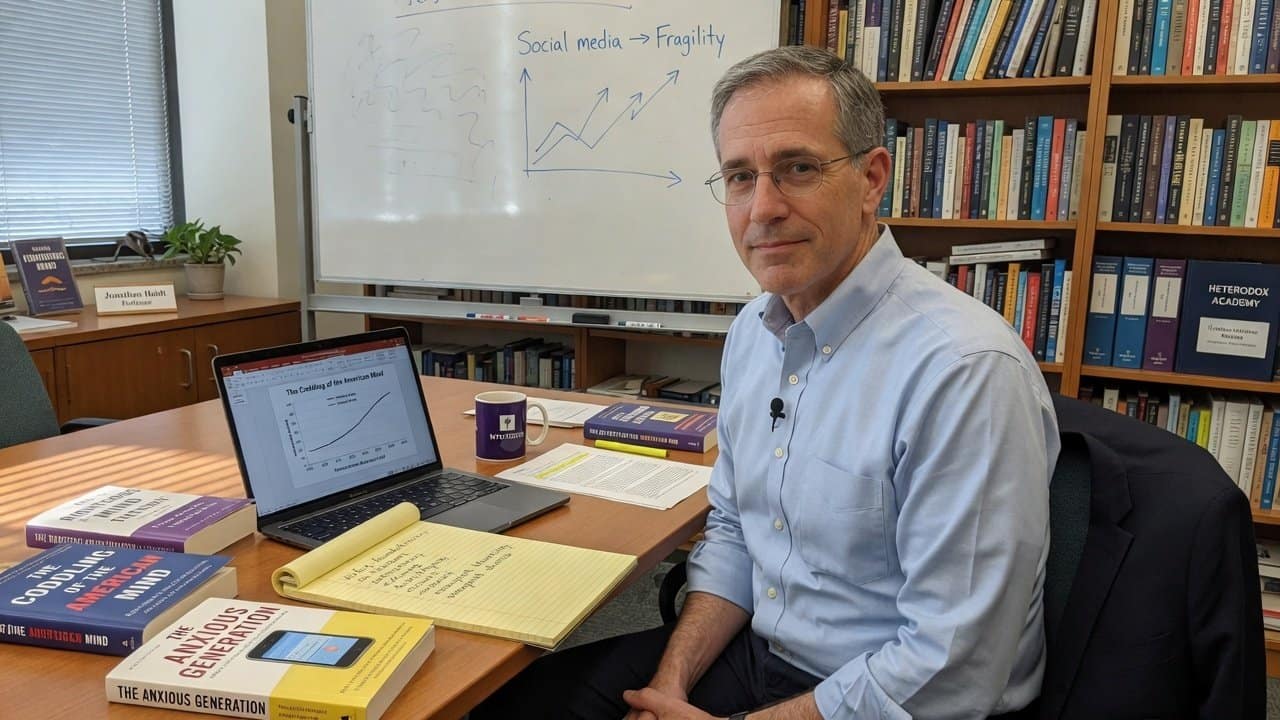
Jonathan Haidt has become one of the most influential thinkers in the realm of social psychology and moral philosophy. His work on the moral foundations of human behavior and political polarization has gained widespread attention.
He offers insights into how human nature is shaped by both evolution and culture, and how these influences can explain some of the most pressing issues facing society today. But Haidt isn’t just an academic—his work provides practical wisdom that touches on everything from our moral intuitions to the divisions that currently plague modern politics.
In this blog, we’ll take a closer look at Jonathan Haidt’s contributions, exploring his groundbreaking research on morality, political divisions, and social issues, along with his more recent thoughts on how we can bridge our societal divides.
The Foundations of Morality: Haidt’s Moral Foundations Theory
One of Haidt’s most impactful contributions is his Moral Foundations Theory (MFT). This theory suggests that human morality is not solely based on rational thought, as many have assumed. Instead, morality is primarily influenced by a variety of innate “moral foundations” that are shaped by both biological and cultural factors. Haidt identifies five key foundations of morality:
- Care/Harm: The idea that we are intuitively inclined to protect others from harm.
- Fairness/Cheating: Our sense of fairness is tied to the concept of justice and reciprocity.
- Loyalty/Betrayal: This foundation deals with loyalty to groups and the betrayal of that loyalty.
- Authority/Subversion: Humans are wired to respect authority and social hierarchies.
- Sanctity/Degradation: This concerns the reverence for purity and sanctity, often in relation to religion or culture.
Haidt’s framework helps explain the vast differences in moral perspectives across various cultures and political ideologies.
For instance, while liberal groups often prioritize Care/Harm and Fairness/Cheating, conservative groups tend to balance all five foundations, giving more weight to Loyalty/Betrayal, Authority/Subversion, and Sanctity/Degradation.
This explains why liberals and conservatives often find it difficult to relate to each other’s moral perspectives, especially in political debates.
Politics and Division: Haidt’s Analysis of Political Polarization
Haidt’s research takes a deep dive into the polarization of modern politics, especially in Western societies. His book, The Righteous Mind: Why Good People Are Divided by Politics and Religion, explores why people with different political views often clash, even when they hold similar moral values.
Haidt argues that while humans are naturally inclined to have strong moral intuitions, we are also heavily influenced by group identity, and this often leads to an “us versus them” mentality.
In the U.S., the political divide is particularly stark. Haidt has observed that the shift toward extreme partisanship is driven by a deepening tribalism where each side views the other not just as wrong, but as immoral.
This dynamic is amplified by social media, where echo chambers create an environment in which people are constantly exposed to information that reaffirms their preexisting views, making compromise and mutual understanding more difficult.
The Role of Social Media in Modern Discourse
Jonathan Haidt has also been vocal about the role of social media in shaping modern discourse. In his more recent work, Haidt has highlighted the destructive influence of platforms like Facebook and Twitter on public dialogue.
He believes these platforms amplify negativity, outrage, and misinformation by rewarding content that elicits strong emotional reactions. This, he argues, accelerates political polarization and undermines the possibility of rational discourse.
Haidt suggests that social media platforms encourage a “culture of outrage,” where users are incentivized to express extreme viewpoints, often at the expense of productive dialogue.
This, in turn, leads to the deepening of divides and a weakening of social trust. His insights into the harmful effects of social media are crucial as we navigate the challenges of our increasingly digital and connected world.
Solutions to Polarization: A Call for Understanding
Despite his critiques of modern society, Haidt is not without hope. He advocates for a return to civil discourse and empathy, urging people to try to understand the moral intuitions behind opposing political views.
Haidt believes that by acknowledging the moral foundations of others, we can begin to bridge the divide between political and ideological factions.
Furthermore, he stresses the importance of education in fostering empathy and understanding. By encouraging students to think critically about moral and political issues, we can help future generations better navigate societal challenges and engage in more constructive dialogue.
Conclusion
Jonathan Haidt’s work has provided us with valuable tools to understand the complexities of human morality, social division, and political polarization.
By recognizing the foundational moral values that guide human behavior, we can better appreciate the diverse viewpoints that shape our world.
While the challenges he identifies are significant, his solutions of empathy, understanding, and constructive dialogue offer hope for a more cohesive society.
As we continue to grapple with the challenges of polarization and moral division, Haidt’s work remains a crucial reference point for anyone seeking to navigate the complexities of our modern world with compassion and clarity.