
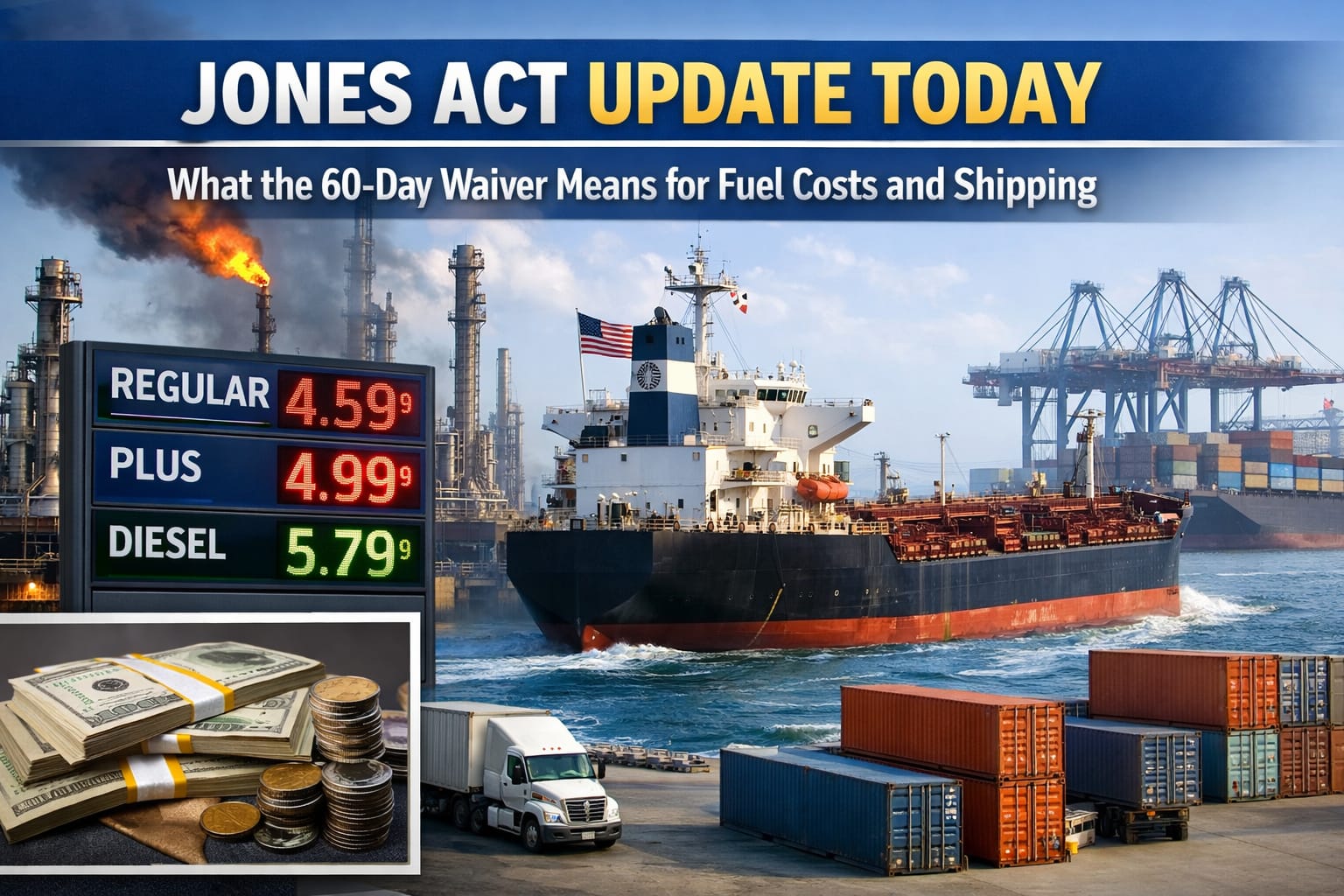
The Jones Act is back in the spotlight because a law most people rarely think about has suddenly become part of a much bigger story about fuel, shipping, and supply pressure. On March 18, 2026, the Trump administration announced a 60-day waiver of the Jones Act, opening the door for foreign-flagged vessels to move fuel, fertilizer, and other goods between U.S. ports. The move came as oil market stress and shipping disruption linked to the Iran conflict pushed energy concerns higher.
Why the Jones Act suddenly matters again
This law matters because it shapes how goods move inside the United States by water. The Maritime Administration says the Jones Act is part of the Merchant Marine Act of 1920 and, strictly speaking, applies to merchandise moved by water between U.S. points. Under that rule, the cargo must travel on vessels that are U.S.-built, U.S.-owned, U.S.-registered, and crewed by Americans. In simple terms, it keeps domestic water shipping inside a protected U.S. system.
That protection was designed to support both the economy and national defense. MARAD says domestic shipping is considered critical to reliable service and sealift capacity if the country faces a major military need. Supporters of the law see it as a safeguard for American shipbuilding, American maritime jobs, and a merchant fleet the country can count on in a crisis.
What changed on March 18
What changed today is not the law itself, but the decision to pause it for a short time. Reuters reported that the administration announced a 60-day waiver that temporarily allows foreign-flagged vessels to carry fuel, fertilizer, and other cargo between U.S. ports. White House press secretary Karoline Leavitt said the step was meant to help ease short-term oil market disruption. Reuters also reported that the administration linked the move to price increases and supply strain caused by the Iran conflict.
AP reported that the wider backdrop is a sharp jump in oil pressure after tanker movement through the Strait of Hormuz was badly disrupted. That matters because the U.S. is part of a global oil market, even if it produces large amounts of oil at home. AP also noted that the national average price for regular gasoline had climbed to about $3.84 a gallon on Wednesday, showing why a shipping rule has suddenly become kitchen-table news.
Why this waiver is such a big deal
A Jones Act waiver is not routine. MARAD says exemptions are rare and can only be granted in the interest of national defense. The agency also notes that the final decision on a waiver comes from the Secretary of Homeland Security. That is why this new 60-day pause stands out. It is a serious federal step, not a minor policy tweak.
The practical goal is easy to understand. If more ships are allowed to move fuel between U.S. ports, refiners and distributors get a larger pool of vessels to work with. That can help cargo move with more flexibility at a time when the normal energy flow is under stress. Reuters said that is exactly how officials are framing the waiver.
Will this actually lower prices?
That is where the story gets more complicated. The waiver may help loosen a shipping bottleneck, but analysts are not treating it like a magic fix. Reuters reported that some experts doubt it will have a meaningful effect on prices at the pump. AP made the same point, saying more shipping options may bring some relief, but the move is not a sweeping answer to a global oil shock.
So the clearest way to read this moment is simple: the Jones Act is in the news because Washington has chosen to relax one of the country’s best-known shipping protections in response to a fast-moving energy and supply problem. The waiver is important, the law behind it is older than many realize, and the real test now is whether this short-term opening changes anything people can actually feel in the weeks ahead.