
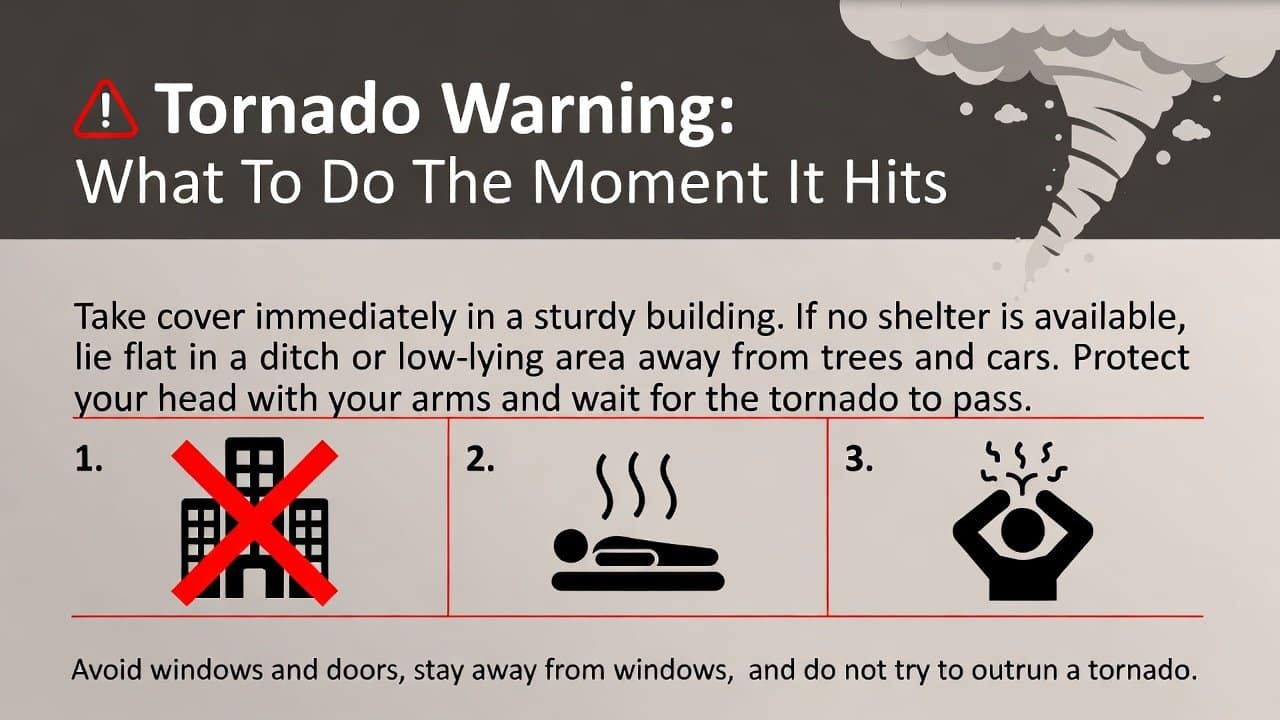
A tornado warning changes the moment. It is not a heads-up for later. It means a tornado has been seen or picked up by weather radar, and the danger is close enough that people need to move right away.
The National Weather Service says a warning points to imminent danger to life and property, and it usually covers a much smaller area than a watch, often around the size of a city or small county.
That is why the words matter so much tonight. The Storm Prediction Center said Tuesday’s severe weather setup stretched from the Mid Mississippi Valley across the Ohio Valley and southern Great Lakes, with another trouble zone across western Oklahoma and far northwest Texas.
Its official outlook called for scattered severe storms with damaging wind gusts and large hail, while some areas also carried tornado potential.
The Weather Pattern Behind The Sudden Concern
By Tuesday evening, the Storm Prediction Center had multiple severe thunderstorm watches in effect, and several of them included the line “a tornado or two possible.” Watch 79 covered western and central New York and northern Pennsylvania.
Watch 80 covered northern Ohio and northwest Pennsylvania. Watch 81 covered western Oklahoma and western North Texas. Watch 82 covered northern Indiana and northwest Ohio. Watch 83 covered eastern Ohio, western and northern Pennsylvania, and far northern West Virginia.
That wide stretch of storm zones explains why people are checking phones, radar, and local alerts so closely. Even when the main threat in a watch is wind or hail, the official wording can still include tornado risk, which is exactly why forecasters keep telling people not to wait for visual proof before taking cover.
How To Tell Which Tornado Alert Calls For Immediate Action
The National Weather Service breaks it down clearly. A tornado watch means conditions are in place for tornadoes to form. A tornado warning means one has been sighted or indicated by radar, so action should start at once.
A tornado emergency is the highest alert level and is used when a violent tornado is on the ground and catastrophic damage is confirmed.
That difference matters because a lot of people lose time trying to figure out whether they should keep watching the sky. Once the alert says warning, the decision is already made for you. Move first, check details second. That is the safest reading of the official guidance.
The Best Place To Shelter When The Alert Goes Off
The best place to go is a safe room, basement, storm cellar, or a small interior room on the lowest floor of a sturdy building, away from windows.
If you are in a mobile home, a vehicle, or outside, the National Weather Service says to get to the closest substantial shelter and protect yourself from flying debris. It also says not to try to outrun an approaching tornado in a vehicle.
Phones play a bigger part in that life-saving chain than many people realize. The National Weather Service says Wireless Emergency Alerts are sent automatically to WEA-capable phones during an emergency, with no signup required.
The alert is designed to tell you the type of threat, the time window, and the action to take. The agency also says NOAA Weather Radio, local TV and radio, and other trusted alerts should back up what comes to your phone.
The One Thing You Should Not Delay
A tornado warning is not a maybe. It is the point where waiting stops. With severe weather spread across several states Tuesday evening and multiple official watches carrying at least some tornado potential, the smartest move is simple: know where you will go before the next alert sounds, and go there fast when it does.